


The S&P 500 index has been on a remarkable run since the beginning of 2023, and even after the recent pullback it is still positive year to date. Three strong years in a row is something to be grateful for, but it is also important not to be lulled to sleep by low volatility and strong returns. Investing comes with risk, and it will not always be smooth sailing.
We want to provide an update on our tactical positioning as well as discuss some of the key risks influencing markets today. It’s also important to point out that risk is part of investing. We don’t “jump in” and “jump out” of the markets due to risk. Instead, think of it like a dial where we can choose to be more aggressive or more conservative over time. As markets rise and risks rise, we often find ourselves turning the risk dial lower a bit. That’s where we are today and we’re going to recap the main reasons behind our positioning. When there are down days in the market, we want to help you understand that we are prepared. Then, when an opportunity arises we’ll be in a position to capitalize on it rather than being part of the fear or panic. As you read through this, if you want to get into more detail please know we’re just an email or phone call away.
Tactical Portfolio Positioning
Based on the current market level along with an understanding of opportunities and risk, we determined it was prudent to move a portion of the portfolio into “dry powder”. This means we added conservative holdings that we expect to hold their value in a downturn so we can put them back to work later. While it’s never as exciting to have a portion on the sidelines our job is not only to grow your money but also to protect what you’ve made.
Here is what that means:
• This is a hedge, not an exit. Accounts will continue to move up and down with the market.
• Dry powder. When others are fearful, we will have money ready to buy at lower prices.
• Tactical, not permanent. This position won’t be held forever. It is built for exactly this kind of environment and to set you up for the next cycle of growth.
For those of you who were with us in 2020, this will sound familiar. We reduced risk ahead of the COVID shutdown, and when the world was panicking and markets had sold off, we put that dry powder back to work. If you’d like to revisit how we did this during COVID, you can find our de-risking post here: Tactical Risk Reduction Amid Rising Conflicts and our re-entry post here: COVID-19 and Your Portfolio.
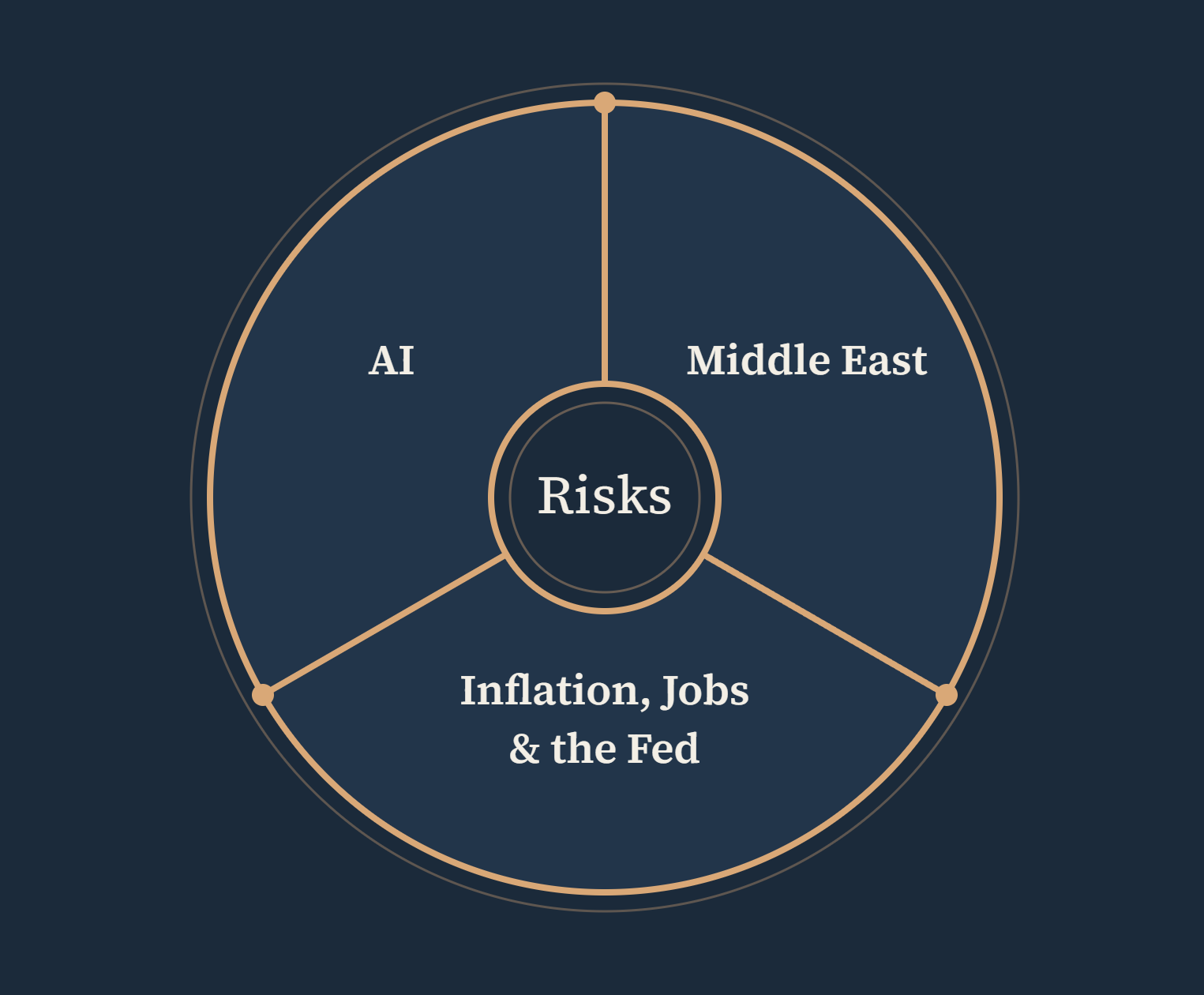
If you do not follow the markets as closely, what follows may strike some nerves. But remember, there are always risks within financial markets. It is our job to watch them closely and make sure you are invested appropriately. Right now, there are three key risks on our radar: the AI trade, the US/Iran conflict, and inflation.
1. AI: The Elephant in the Room
AI has been the main engine of this bull market since 2023, and that story is now being questioned.
• The selloff. On November 5, the main semiconductor index had its second-worst day since 2020, behind only March 16, 2020. Nvidia, the poster child of the AI boom, fell roughly 30% from its October high, erasing close to $2 trillion in market value in a little over a month.
• The spending. Microsoft, Alphabet, Amazon and Meta expect to spend roughly $730 billion this year, and Wall Street expects that to climb to about $935 billion in 2027. Include Oracle and the other large tech companies and the total is expected to top $1 trillion by 2027. That is a lot of zeros.
• The cash. Free cash flow, the cash left over after running the business and paying for new investment, has turned negative at several of the biggest spenders. Over the last twelve months, Amazon’s free cash flow was negative $42 billion, compared with positive $15 billion a year earlier, and Alphabet has been negative for two quarters in a row. Meta swung to negative $2 billion last quarter from positive $10.6 billion a year ago.
• The financing. Borrowing is getting harder for the “smaller” players. Even Oracle, which reported negative free cash flow of $5 billion last quarter while planning $90 to $95 billion of spending this fiscal year, depends heavily on debt, and the companies below Oracle depend on it even more. In late October, Elon Musk observed that debt markets had almost entirely shut off for data center companies without substantial revenue outside AI, and shares of CoreWeave, Nebius and Iren each fell at least 30% in October as credit tightened.
• Washington. Democrats won control of both the House and the Senate in the November 3 midterms, many of whom campaigned on tighter AI regulation. Analysts also noted that Democratic wins in governors’ races could slow new data center development through tighter permitting.
AI appears to be a powerful tool that will change the world. But as investors, what matters is how it drives growth and the bottom line. Four years into the buildout, that payoff is still largely unknown. The question isn’t whether companies are spending money on AI, it’s what the return will be on that spending. When financing dries up, projects get delayed or canceled, and that ripples through to the chipmakers, builders and suppliers that have powered this rally.
2. The Middle East: Risk of Re-escalation
The war with Iran began on February 28 and is now in its ninth month with no end in sight. It has received less attention lately, with the midterms and AI dominating the news, but the past week has been a reminder that it is far from over.
• Renewed attacks. After a roughly two-month pause, Iran resumed attacks on US facilities in Bahrain, home of the Navy’s 5th Fleet. On Wednesday this expanded to a US air base in Kuwait, in apparent retaliation for American strikes the day before.
• A third carrier. The USS Theodore Roosevelt arrived in the region over the weekend, joining two other carriers enforcing a blockade of Iran. Three carriers in the region at once is a sizeable force prepared for hostilities.
• Saudi oil under fire. Yemen’s Houthis have stepped up attacks on Saudi Arabia, damaging an Aramco building in Riyadh and targeting a key oil pipeline and a Red Sea oil facility.
• Shipping pressure. 37 ships were attacked in the Strait of Hormuz in October, the most of any month since the war began.
Oil prices reflect this, with Brent crude around $95 a barrel this week. Further escalation would likely push energy prices higher and weigh on global markets, which brings us to our third risk.
3. Inflation: Between a Rock and a Hard Place
Inflation is moving the wrong way. Consumer prices rose 0.4% in October, or roughly 4% over the past year, and “core” prices (which exclude food and energy) rose 0.3% for the third month in a row. Two forces are doing most of the work:
• The AI buildout. Hundreds of billions of dollars are flowing not just to data center builders but to electricians, steel and power suppliers, and everyone else along the chain. ING estimates that AI investment accounts for roughly a third of US economic growth this year. That has supported GDP, and with it, inflation.
• Energy. Higher oil prices from the war first lifted headline inflation. Nine months in, those costs are seeping into the prices of everyday goods and services.
The Fed’s response creates its own risks:
• Rate hikes. The Fed raised rates in September for the first time in three years and held in October, with two officials pushing for another hike. Markets now see close to an 80% chance of another increase in December.
• The wrong tool. Small rate hikes do little to slow AI spending by companies with deep pockets, and nothing to lower the price of oil. Hikes can slow the rest of the economy without fixing the two main drivers of inflation.
• Cracks in the job market. Employers added 165,000 jobs in October, well above expectations, and the unemployment rate dipped to 4.1%. Underneath, though, wage growth has slowed to 3.1%, matching its weakest pace in more than five years, and it now trails inflation.
That last point matters. As the J.P. Morgan chart below shows, when wage growth has cooled from its highs back toward its long-term average, unemployment has often jumped soon after.
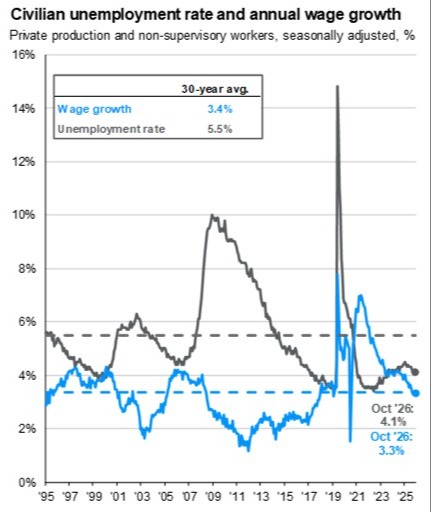
Source: BLS, FactSet, J.P. Morgan Asset Management.
Private production and non-supervisory jobs represent just over 80% of total private nonfarm jobs.
U.S. Data are as of November 17, 2026.
This is where the risks connect. If the AI selloff turns into an AI spending slowdown, the economy loses one of its biggest sources of growth, along with the jobs that come with it, from construction crews to equipment makers. Add a Fed that is raising rates and higher energy costs, and the margin for error gets incredibly thin.
We are never cheering for down markets, but please know that we are positioned with a risk-off tilt in our tactical models. This positions you to benefit from the instability. We realize while the downside is occurring that there will be lower statement values, and we’re here to talk with you if you want to dive into any of this further.
If you want to use this as an opportunity to revisit the risk/return tradeoff in your accounts then this would be a great time to connect. Just reply to this message or call our team.